As average amount in 401k takes center stage, it’s no wonder why this vital figure has become the focal point for financial savviness. The concept of a 401k plan has evolved, but its core purpose remains the same – to provide employees with a solid foundation for their golden years. A look at the trends and statistics surrounding this figure reveals a more nuanced picture, one that’s influenced by age, income, and employment tenure, among other factors.
The numbers don’t lie; a 401k balance has become a key aspect of an employee’s financial security. But the journey to achieving this isn’t without its challenges. Employers and policymakers are taking a closer look at how to boost the average amount in 401k, making it easier for workers to save for the future. Whether it’s exploring new investment options, automating plan participation, or tweaking policy recommendations, the goal remains the same – to help retirees live their best life.
Policy Implications for Boosting the Average 401(k) Amount: Average Amount In 401k

As the United States continues to grapple with the issue of retirement savings, policymakers and financial experts have turned their attention to the 401(k) system, a cornerstone of American retirement planning. Despite its flaws, the system remains the primary means of providing employees with a nest egg for life after work. However, the reality is that many workers rely too heavily on their 401(k) accounts, often at the expense of other essential expenses, such as healthcare, housing, and debt repayment.
This precarious reliance on 401(k)s, combined with the challenges posed by economic uncertainty and increasing life expectancy, underscores the need for policy reforms aimed at boosting the average 401(k) balance.Implementing automatic enrollment in employer-sponsored retirement plans is one strategy that has gained traction in recent years. By making it easier for workers to participate in the 401(k) system, automatic enrollment can help increase employee engagement and foster good savings habits.
This is because workers are less likely to opt out of a 401(k) plan that automatically deducts a fixed percentage of their salary each month. According to a study by the Employee Benefit Research Institute (EBRI), automatic enrollment can boost 401(k) participation rates by as much as 20 percentage points.Automatic enrollment is just one piece of the puzzle, however. To further boost 401(k) balances, policymakers might consider expanding catch-up contributions, which allow workers aged 50 and older to contribute an additional amount to their 401(k) accounts.
Currently, catch-up contributions are limited to $6,500 per year, a relatively modest amount considering the challenges faced by many workers in this age group. Increasing this limit, or even eliminating the age requirement altogether, could help more workers build a cushion for retirement.In addition to these measures, policymakers might also consider incentivizing employer matching, a practice where companies contribute a percentage of an employee’s 401(k) contributions to the employee’s account.
By making employer matching more attractive, policymakers could encourage more companies to offer this benefit, which is a key factor in building 401(k) balances. For example, a study by the Pew Charitable Trusts found that employees who participate in employer matching tend to have higher 401(k) balances than those who do not participate.
Implementing Automatic Enrollment
Automating 401(k) enrollment can have a profound impact on retirement savings, particularly among low- and moderate-income workers. By making it easier for workers to participate in the 401(k) system, automatic enrollment can help increase employee engagement and foster good saving habits. This is because workers are less likely to opt out of a 401(k) plan that automatically deducts a fixed percentage of their salary each month.
- Higher participation rates: According to a study by the Employee Benefit Research Institute (EBRI), automatic enrollment can boost 401(k) participation rates by as much as 20 percentage points.
- Increased savings: By automatically enrolling workers in a 401(k) plan, employees are more likely to contribute to their retirement accounts regularly, rather than skipping contributions in times of financial stress.
- Improved employee retention: Companies that offer automatic enrollment may find that their employees are more likely to stay with the company, as they feel more secure in their financial future.
Expanding Catch-up Contributions, Average amount in 401k
Catch-up contributions, which allow workers aged 50 and older to contribute an additional amount to their 401(k) accounts, are a vital tool for helping workers build a cushion for retirement. However, the current limit of $6,500 per year, combined with the age requirement, may not be enough to help many workers achieve their retirement goals. Increasing this limit, or even eliminating the age requirement altogether, could help more workers build a secure financial future.
Workers aged 50 and older may face greater expenses in retirement, such as healthcare costs and debt repayment, which can make it harder to save for retirement.
| Scenario | Catch-up Contribution Limit | Pension Benefit Reduction |
|---|---|---|
| Current Limit ($6,500) | $6,500 | 10% Pension benefit reduction |
| Increased Limit ($10,000) | $10,000 | 5% Pension benefit reduction |
| No Age Requirement | $10,000 | 0% Pension benefit reduction |
Incentivizing Employer Matching
Policy Implications for Boosting the Average 401(k) Amount: Average Amount In 401k
Commonly Asked Questions
Q: What percentage of employees participate in a 401k plan?
A: According to the Employee Benefit Research Institute, around 50% of employees participate in a 401k plan, but participation rates vary significantly across different industries and age groups.
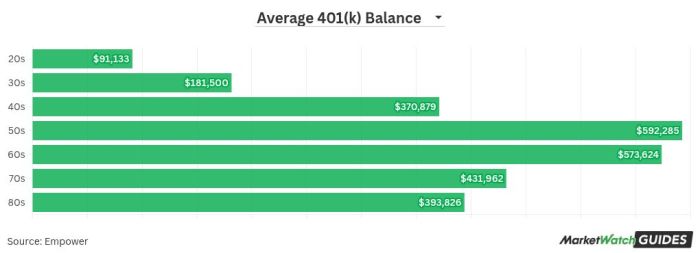
Q: What’s the average 401k balance for workers in their 50s?
A: A recent study estimates that the average 401k balance for workers in their 50s is around $130,000, but this figure can range from $50,000 to over $200,000 depending on factors such as income level and investment choices.
Q: Can employees contribute more to their 401k if they’re behind on retirement savings?
A: Yes, catch-up contributions allow employees aged 50 and over to contribute an additional $6,500 to their 401k in 2023, helping them make up for lost time and build a more substantial retirement nest egg.
